

Death of the Reader
DEATH OF THE READER —
disclaimer: This morning’s essay grew so long because it had to, and there’s an irony to whether you, Reader, are up for a 3500 word read about the Nadir of American Literacy.
//
In his 1967 article, “THE DEATH OF THE AUTHOR” Roland Barthes argues against traditional criticism which relies heavily on the Author’s biography and intentions to determine a text’s meaning. Barthes instead said that the author is merely a “scriptor” who exists simultaneously with the text, and that meaning is created by the Reader, not the Writer.
Similarly, just 2 years later, Foucault writes “WHAT IS AN AUTHOR?” — basically concluding that the “Author” is not a natural, creative genius or the ultimate source of a text’s meaning, but rather a “functional principle” constructed by society to limit, exclude, and organize discourse.
— In both theories, a supreme responsibility befalls the reader. Now, we can debate whether or not these men were ‘right,’ but what’s fact is this: they had readers and their culture was intellectual… But this article is not about these intellectuals or that culture.
Rather, I’m writing about the current fall in literacy and rise in anti-intellectualism. Specifically in America, as that’s where I am and where I teach writing to a cohort taught that guessing, skimming, and avoidance are the way. Who don’t just say “I’m bad at reading” “Im not a good writer” “I never read books” “I don’t like writing” But who find this okay. While it’s dire and the Death of the Reader is already underway, we may not need a funeral yet…
This sort of begins because the story I’m seeing about Literacy in America is discombobulated. Whole language versus Phonics, technologies, pandemic, social media, artificial intelligence… oh and the story of a prestigious institution where one single Academic creates a Philosophy, a Mayor mandates that philosophy at scale, a Publisher monetizes it nationally, Teachers training programs propagate it, and the evidence against the philosophy has to accumulate for decades before any institutional inertia finally cracks…
Let’s get into it all.
// Actually, first, it behooves me not to mention that my personal stake is borne of my now-six years teaching college level English, sometimes called Rhetorical Arts, sometimes in the form of literature or creative writing workshops, but mainly the grunt work of CORE curriculum introductions to “academic writing” — as an adjunct English Professor, there may be no other tenure more fit than first year curriculum teachers to comment on national literacy practice and performance… First Year Writing is a very particular fire to be forged in; I’m not teaching another college course, every year I spend the sixteen week semester with sixty-some students, guiding them through the process of writing which inevitably reveals everything from personal goals, histories, behaviors, anxieties, expertise, skills, doubts, worldviews… The English classroom is a diverse place when dozens of students taken on personal writing and argumentative essays aimed at popular culture; the very culture reflecting back at them their world views and identities and anxieties, but I digress… suffice to say I see A LOT in the first year writing room and though I’m not a full national sample— I’ve taught in California and South Carolina— I’d say about sixty students a semester for six years is enough to catch a pattern compounding in real time. //
All this to say that for me, the issues I see with Literacy came to my attention organically while serving as a teacher AND because that meant adjusting to an increasingly different cohort semester by semester. Since I began teaching in 2017-18, there are two main historical timelines that bear upon this story; they are
#1 the history of phonics and whole language in American curriculum
#2 the acute covid crisis and its impact (especially on American students)
In a personal way, the third timeline is my position within that matrix, so my observations as a teacher of the 2018-2026 cohorts do skew and bias the perspective— but hopefully you see that my stake is in addressing the problems, finding solutions, tracing this hydra back to its head.
Historical Timeline #1 requires the most background, so let’s get into the phonics vs whole language debate. Right now let’s focus on WHEN the shift from phonics to whole language occurred, not so much why.
Whole Language “peaked” institutionally in the late 1980s–early 1990s, then rebranded as Balanced Literacy through the 1990s–2010s. As for its very-very beginnings, Whole Language does trace back to one Horace Mann* in the 1800s, which explains why by the 1950s the philosophy was considered “conventional wisdom,” with the Look-Say method driving the Dick and Jane books that flooded schools from the 1940s through the early 1960s.
[*Mann’s most interesting tidbit, if you ask me, relates to corporal punishment. He opposed it, and was a lifelong education reformer that initiated America’s culture towards making schools more humane, systematic, and focused on developing citizens—not just enforcing obedience. Puritan ass pedagogy we came from… ]
The rebrand for Whole Language was due to evidence mounting against it;”balanced literacy” claimed to blend phonics with whole language but in practice leaned heavily toward whole language. Students were still encouraged to guess words or skip over them, that’s the key danger in the Whole Language Philosophy and it connects straight to the techno-social media era… but we’re not quite there yet. I’d be remiss not cover LUCY CALKINS in this mess. And if that name’s not familiar, I hope it sounds as sinister as her impact was.
Why if Whole Language finally earned its rightful Bad Guy™ title did the sneaky Balanced Literacy so easily take hold of American elementary classrooms in the 1990s?
Lucy CALKINS and her “units of study” curriculum.
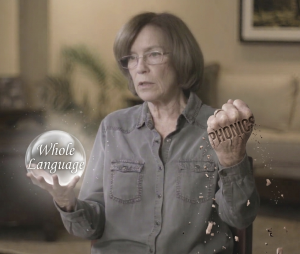
This Whole Language-in-disguise took New York City schools hostage for nearly two decades. And it was faaaaar from a grassroots adoption based on evidence or performance; nope, this was a good old fashioned mayoral decree that put Units of Study on the curriculum. Why then-Mayor Bloomberg asked Calkins for a formal curriculum I do not know… but she readily adapted her “Reading Workshop” [whole language] into Units of Study [balanced literacy] specifically for the mandate. Of course the mandate caught the TCRWP* by full surprise because Mayor Bloomberg had approached Calkins personally, never formally involving TCRWP as an institution. To fast forward a little — by October 2023, Columbia University shuts down the TCRWP and dissolves the program because its methods are “misaligned with scientific research on reading, particularly regarding the critical importance of phonics-based education in early development. The state of your children’s education is a clusterfuck when when the institutional press-release writes: “Teachers College “will ensure that its professional development programs are informed by the latest research and evidence.””
Folks, it isn’t just the education that’s a mess here. And although my research revealed not a grand conspiracy, there’s no doubt this story’s steeped in classics of corruption and power ; so let’s wrap this up with one look under the rug before returning to the present state of Literacy. Which, to be honest, is way shadier than the Calkins scenario; though my point remains that both are preying on the education of Americans.
Okay, okay — so what Bloomberg and Calkins started in NYC formed the agenda for a national undertaking; Obviously. With NYC as a launchpad, the curriculum went national through institutional infrastructure and publishing money. By 2013, Teacher’s College (Calkins/WL) had affiliations with over 600 schools and extensive involvement in cities like Chicago, Albany, and Seattle, with over 170,000 teachers attending its week-long institutes. Calkins herself estimated that one in four U.S. elementary schools mandated the curriculum, with many others using similar BL methods without formally implementing Units of Study.
Understand that the business model wasn’t just books. It included everything from curriculum packages, district licenses, consultant contracts, literacy coaching, workshops, conferences, administrator training, ongoing professional development. That ecosystem became extremely profitable; and created inertia. When districts invest millions, teachers train for years, administrator build careers around it and publishers make huge revenue a system doesn’t just go away.
Heinemann Publishing — home to Calkins, Fountas, and Pinnell — dominated a market that, according to the Association of American Publishers, saw districts spend $1.33 billion on reading programs for pre-K through sixth grade in 2019 alone, more than on all ELA materials for middle and high school combined. When Houghton Mifflin Harcourt acquired Heinemann, executives were explicit that revenue expectations would increase, and the pressure to sell district-wide program adoptions intensified. In 2022, Calkins revised her curricula to include more phonics. By 2023, Heinemann’s revenue had declined roughly 75% from its 2019 peak. Calkins framed the revision as progress rather than correction.
The NRP report endorsed neither side explicitly, and its density and lack of policy recommendations made it difficult to translate into classroom change. So Whole Language/Balanced Literacy’s grip persisted well into the 2010s under different branding and with a lack of structured anti-WL/ pro-Phonics initiative. As well as that institutional backing.
Nonetheless, The NRP (2000) and NCLB (2002) were the first federal pushes in favor of Phonics, which gets rebranded as THE SCIENCE OF READING.
[THE SCIENCE OF READING is the new Good and Scientific™ curriculum, for the record]
The Science of Reading movement — which drove actual classroom policy change — gained traction slowly after the 2010s… Hard Words (2018) was the audio-documentary that first sent shockwaves across the U.S. by revealing what was missing in schools. Sold a Story was Emily Hanford’s 2022 blockbuster podcast — downloaded more than 3.5 million times — which specifically targeted how disproven ideas had made their way into the country’s most popular reading curricula, then gained state-legislative traction through the early 2020s.
That the tide turned on the back of a podcast — not a federal mandate, not a peer-reviewed replication — just adds to the irony of this story.
The poster child for Science of Reading curriculum is a cinderella story coming of of Mississippi. In 2013, Mississippi passed the Literacy-Based Promotion Act, shifting instruction from BL to Science of Reading for K-12 education. Ready for this? Starting at 49th place in fourth-grade reading proficiency in 2013, Mississippi now ranks NINTH in fourth-grade literacy without adjustments for demographics. Up close; African-Americans in Mississippi outperform African-Americans in 47 of the other 49 states in reading; Mississippi’s Hispanic students lead the nation for their demographic in reading (and second place in math).
That’s ludicrous levels proof in the pudding. Rightfully so they call it “The Mississippi Miracle” and its one of many successful overhauls in k-12 curriculum. Thus concludes the long-winding history of Whole Language vs Phonics… the takeover was messy and is NOT concluded. It should be noted that phonics persisted culturally (hooked on phonics, homeschooling, and curriculums that ‘hung on’) AND that phonics now re-enters households freely through platforms like YouTube and iPads (Miss Rachel, etc.) yes I fact checked what language theory Miss Rachel uses.
But for the purpose of continuing this story here, my investigation into the downstream flurry of failures the WL education sets us up for… Based on the timelines here we can say that the 18–30 cohort right now (born 1996–2008, K–3 during ~2001–2016) is the demographic window most saturated by BL.
Could the current literacy crisis be less about decline than about timing? The assumption this question rests on: investigating if the cohort educated during the peak of Whole Language pedagogy now encounters AI tools that compensate for skills they were never fully given the chance to build — or do they take advantage.
How do we know literacy rates are failing anyway? The numbers, duh. Ok but what does that look like? K-12 is always the focus point for such conversations; but I want to investigate where it gets us.
What do the 18-30 year old inculcated by CALKINS become? As college students, as career people, as social beings?
As for the latest studies, “They Don’t Read Very Well” (2024)* is an excellent up-close example of the result. The study has been mis-reported by the public slightly, but that nuance can demonstrate, well, the nuance of this literacy problem. So let’s be precise, the mistake people are making when interpreting this study is that they assume the study tests for ~basic literacy or just plain old ‘literacy’ when in fact its testing ‘functional’ literacy. And the college level students’ failure to demonstrate functional literacy is even more telling than say, dropping into an underserved community to prove students K-12 can’t read difficult sentences out loud (I’m thinking of the recent viral video featuring grade schoolers struggling to read out loud a line featuring words like: “guache” and “silhouette”)
*https://muse.jhu.edu/pub/1/article/922346
What we learn from the college student’s failure to perform functional literacy is exactly the end-result of Calkins inculcation: a non-strategy of guessing, skimming, and avoidance—and a cohort that’s internalized “I’m bad at reading” or “I don’t like reading” as identity.
So when the headline on social media reads: “They cant read the first page of a Dickens novel” it is not accurate because what’s actually happening is that students “will not” read.
Years of avoidance, skimming and guessing have atrophied the muscles that never formed; they now fail to engage the very function of reading, without the muscles to grapple and grasp at language, meaning. To read is an act of recursion and discovery; but the Whole Language mentality is just the opposite— a resignation that ‘If you don’t know, it don’t matter’… Alas, the true art of reading involves grappling with the unknown, steering our psychic energy towards the means to meaning. Finding a way into ourselves through the world and through ourselves into the world.
They cannot, will not, and do not want to. These are not the same problem and they do not have the same solution. Interventions aimed at decoding gaps don’t touch a student who has already decided reading isn’t for them. Mississippi fixed the “CANT” but nobody has fixed the “WONT” — instead its only gotten harder, thats why today’s students are busy finding a way to check out // but instead of proselytizing too deep into linguistics theory— let’s instead draw a bridge between the individual taught to skim and the last two problem-pieces in our story:
Timeline #2 COVID and Technology (mainly social medias and AI)
What damaged our collective health most from the Covid Pandemic is how it paired with escapist entertainments (media to social media) and the advent of an algorithmic, infinite scroll— timeline-wise a moment of perfect chemistry that exploded into a once in a lifetime cultural revolution.
For now it’s left us with ‘brain rot’ ‘bed rot’ and ‘doomscrolling’, as well as a deep mistrust in institutions; namely education, political, and medical institutions.
*deep breaths*
So if you’re with me, we have a Big 3 takeover: First the Whole Language curriculum hijacks literacy formation, then in one fell swoop the meteoric shock of a global pandemic + a technologically-fueled cultural ‘check out’ …an acceleration of tech through artificial intelligence.
It is no wonder students are performing lower than ever; not strictly because they’re less effectively trained but because they see less value in the classroom, lessons, and institutions that deliver them. Each of these problems are myriad and deserve their own essays, but their power to exacerbate the problem of literacy specifically is what Im interested in…
Partly because— if this is a lesson— we cannot make the mistake of pinning all the noise on phones, TikTok, and that socio-cultural severance package we call a Pandemic. This is what I see far too much of, “Its the phones” “it’s the social media” — and while I agree inherently, without connection to the Literacy problem I see very little viability in addressing the problem. Solutions aimed at screen-time or delusions of ‘consuming the right content’ are the chorus of today. But they aren’t working and tomorrow’s technology only gets tougher to fend off.
At this point its just semantics or my ego to be stuck on this point: What if the Whole Language curriculum’s consequences get delayed long enough to be misattributed to phones, TikTok, and pandemic disruption rather than linked to early decoding gaps that only surface later and that these technologies then exploit? But what’s not my ego or semantic is to focus on the EXPLOIT of it all…
It’s not like Whole Language just disappeared; don’t think for a second the Powers that Be haven’t digested the data and learned what they can do with WL curriculum… For example, what if whole language is disproportionately served to ‘underserved’ communities as a way of hindering growth? Roughly half of NYC students in grades 3–8 are proficient in reading. But the racial breakdown is stark: more than two-thirds of white and Asian American students are proficient, while fewer than 37% of Black and Latino children are.
Or from another angle; is Science of Reading enough to fight the tides of technology, short form, and ANTI-Intellectual zeitgeist?
In other words, if handled incorrectly its inevitable that AI, social media and technology advancements function less as a cause than as exposure, exacerbation to literacy: exploit via scaling the coping strategies this group already relies on. Right now we may see it as a long-lagging problem suddenly more visible, but perhaps its an inflection point begging us to do something, institutionally, about the connection between a fall in literacy and rise in anti-intellectualism.
With timeline #2 its about how the CANT (bad education) becomes WONT (anti-intellectual) through three mechanisms, and each one is structural, not incidental.
It’s the First of Three Mechanism: The pandemic literally interrupted schooling but culturally it broke the social contract that gave schooling its authority. If this NADIR of American Literacy wasn’t gravely clear before the Covid-19 Pandemic, the NAEP’s 2022 Nation’s Report Card documented the largest reading score drops in thirty years: fourth-grade reading fell three points, eighth-grade fell three points, both record declines.
These aren’t pandemic learning-loss numbers in isolation — they’re the floor from which a trust-depleted cohort is now expected to climb back, toward texts, under the authority of institutions they watched visibly falter.
Second: WL trained skim, infer from context, move on if meaning doesn’t resolve quickly. TikTok’s algorithm rewards exactly those behaviors and punishes the opposite — slowness, recursion, grappling. The student trained to skip hard words and the student trained to swipe past slow content are running the same cognitive subroutine. They’re not just coexisting forces; one is the digital operationalization of the other. And crucially, social media didn’t just reinforce the behavior — it rebranded the shame. “I’m not a reader” moved from private coping mechanism to public aesthetic. There is now cultural permission, even cachet, in the anti-intellectual posture. WL produced the avoidance; the algorithm converted it into performed identity; the will-to-WONT calcifies.
Third: generative AI is the logical endpoint of the skip-and-approximate strategy. WL’s non-method was if you don’t know, guess from context and move on. AI does exactly that, faster, with “institutional” legitimacy, without requiring the muscle at all. We need to empathize with the reality that students aren’t using AI to avoid reading in spite of their training; they’re using it because of it. The habit and the tool are structurally matched. What WL started as a classroom non-strategy, AI completes as infrastructure.
Let’s finish where we started.
Barthes gave the Reader everything.
He killed the Author so that meaning could live untethered to any one writer’s biography or intention; Meaning in the act of reading itself. Then Foucault followed, arguing that the Author was never a genius anyway, just a social function: a limit, like a boundary condition on discourse. They both said strip that away and let the reader inherit the text. Let the reader become the site of meaning. What a supreme responsibility; the whole weight of interpretation, finally, on the right set of shoulders.
Alas, neither of them mapped what happens when the reader checks out; part of me feels they genuinely couldn’t imagine the culture which allows for it. One that invites it, even.
Is this not just a culture that can’t read; but one that won’t?
One that has internalized I’m not a reader the way you internalize a worldview early and without debate. Trained by a rogue curriculum, by the loudest culture, and by the ever-ready dopamine economy of infinite scroll and short-form video — because today we skim the surface and call it knowing. The Author is dead and now the Reader is dying too. Barthes offered us a liberation and we turned it into a vacancy. If meaning lives in the reader and the reader is gone— not illiterate but absent, not unable but unwilling what is left?
For now we’ve filled that gap with “CONTENT” and “ALGORITHMS” and “ENTERTAINMENT” which is at minimum a testament to how efficiently they exploit the marvelous human intellect. Content, algorithms and entertainment of today give us the brief feeling of meaning — the emotional hit, the consensus, the laugh-track sense of having understood something — without forcing us to grapple with anything real. This is not reading or thinking or learning or struggle… It’s not even like a baby being read to because being read to by a machine and thinking it knows your shape better than you do is the saddest human fate I can think of.
If you ask me— yes, the Reader is dying. It Ma y b e dead. So the question is no longer whether we hold a funeral. Instead we should find out who benefits from the burial, and what the next age of thinking, reading and writing look like.
I plan to think more about that in my next essay on Oral Tradition -> to Literacy of Logos -> back to an Oral/Pictorial tradition.